Order Online or Call Now +92 300 0728887

Difference Between Ping Pong and Table Tennis

Difference Between Ping Pong and Table Tennis

Difference Between Ping Pong and Table Tennis

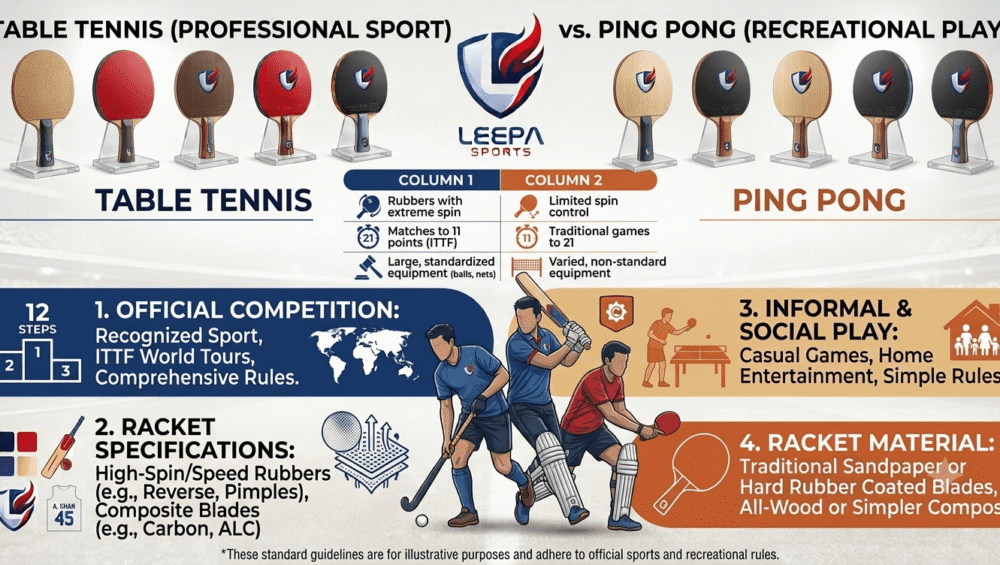
Want to know the Difference Between Ping Pong and Table Tennis? Many people use these two names for the same game. However, the words can have a slightly different feel. “Ping pong” often sounds more casual, while “table tennis” often sounds more formal. Both games use a table, net, ball, and racket.

The main difference usually comes from the setting and playing style. A friendly game may use simple rules and basic equipment. So, whether you call it ping pong or table tennis, you can enjoy the same exciting sport.

1. Difference Between Ping Pong and Table Tennis or Is It the Same Thing?

Ping pong and table tennis usually refer to the same sport. Both games involve two players or two teams. Players stand on opposite sides of a table and hit a small ball over a net. The goal is to make it difficult for the other player to return the ball. You score a point when your opponent makes a mistake.

The main difference comes from how people use the names. “Ping pong” often sounds more casual and friendly. People may use it when playing at home, school, or with friends. “Table tennis” often sounds more professional. Clubs, coaches, and sports events commonly use this name. Still, the basic game remains the same.

2. Why Do People Use Two Names?

The two names became popular over time. People around the world use both terms when talking about the sport. “Ping pong” sounds simple and fun. Therefore, people often use it during casual games. For example, friends may ask each other to play ping pong after school or work.

“Table tennis” sounds more formal. As a result, you may hear it more often in sports clubs and competitions. Players who train seriously may also use this name. However, the name does not decide how someone plays. A beginner can play table tennis, and an expert can enjoy a casual ping pong game.

3. Playing Style Can Be Different

Casual ping pong games often focus on fun. Players may not follow every formal rule. They may also create their own scoring system. For example, friends may decide to play until one person reaches 10 points. They may also change the serving rules to make the game easier.

Competitive table tennis uses a more serious approach. Players focus on speed, spin, control, placement, and footwork. They also follow formal rules during matches. Therefore, competitive games can feel much faster. Players need quick reactions and strong focus. However, beginners can start slowly and build these skills with practice.

Also Read: Official Rules of Table Tennis

4. Equipment May Vary

Casual players often use simple rackets and balls. They may choose equipment based on comfort rather than advanced features. A friendly game does not always need professional equipment. The main goal is to have fun and enjoy time with friends or family.

Competitive players usually pay more attention to their equipment. They may choose rackets based on speed, control, and spin. They also use tables and nets that meet competition standards. Comfortable clothing matters too. Custom Sports uniforms from Leepa Sports ensure a bold look and comfort for a long training session or court performance. 

5. Rules Can Be More Formal

Casual ping pong games may use simple house rules. Players can agree on their own scoring system before they start. They may also decide how to handle certain shots or serves. This makes the game easy and fun for beginners.

Competitive table tennis follows formal rules. Players must follow the correct serving method and scoring system. Doubles games also have specific serving and hitting orders. Officials may watch competitive matches and make decisions when needed. Therefore, serious players should learn the official rules before entering competitions.

6. Leepa Sports Table Tennis Uniforms

Good sports clothing can make a big difference during table tennis. Players need to move their arms and legs quickly. Therefore, clothing should feel comfortable and allow easy movement. A good fit can also help players stay focused during long games and training sessions.

Leepa Sports creates sports clothing for active players and teams. Teams can choose Custom Training Shorts and Sleeveless Shirts for a matching club or team look. With comfortable sportswear, players can focus on serving, returning, and moving around the table. Call Us Today for Custom Sportswear Uniforms!

7. Which One Should Beginners Choose?

Beginners do not need to worry about choosing between ping pong and table tennis. Both names describe the same basic sport. Start by learning the grip, ready position, serve, forehand, and backhand. Then, practice simple rallies with a partner. These basic skills can help you build confidence.

As you improve, you can learn spin, faster shots, and better footwork. You can also join a club or play in friendly matches. Most importantly, enjoy the game and practice regularly. 

Conclusion

The difference between ping pong and table tennis mainly comes down to how people use the two names. Both terms usually describe the same sport, with similar equipment and basic gameplay.

The difference between ping pong and table tennis becomes clearer when you compare casual and competitive play. Ping pong often sounds more relaxed, while table tennis sounds more formal. No matter which name you use, regular practice and comfortable sportswear can help you enjoy the game.

FAQs

1. Are ping pong and table tennis the same?

Yes. Both names usually describe the same sport.

2. Is ping pong more casual?

Yes. People often use “ping pong” when talking about friendly or casual games.

3. Is table tennis more formal?

Usually, yes. Sports clubs and competitions often use the term “table tennis.”

4. Do both games use the same equipment?

Yes. Both use a table, net, ball, and racket.

5. Can beginners play table tennis?

Yes. Beginners can start with simple skills and improve through regular practice.

Official Rules of Table Tennis

Official Rules of Table Tennis

Want to learn the Official Rules of Table Tennis and play with more confidence? Table tennis looks simple, but it has clear rules for serving, scoring, hitting, and winning points. Learning these rules can make the game easier to understand.

The Official Rules of Table Tennis cover many parts of the game. For example, players need to follow the correct serve method. They also need to understand how points work and when a point ends. 

1- Official Rules of Table Tennis – Know the Basic Setup

A table tennis game uses a table, net, ball, and racket. The table has a net across the middle. Players stand on opposite sides of the table. The ball must travel over the net during normal play. It must also land on the correct part of the table. 

The basic setup matters because it gives every player the same playing area. Players should also check that the table and net are in good condition. During play, the ball must stay in the playing area. Players should also keep their movements under control. This helps the game stay fair and safe. 

2. Follow the Correct Serving Rule

The serve starts each point, so players must follow the correct serving method. The server starts with the ball resting freely on an open palm. The player then tosses the ball upward before hitting it. The ball must bounce on the server’s side first. After that, it must travel over or around the net and bounce on the receiver’s side.

Players should also make sure the serve follows the required rules. The ball should stay visible to the receiver during the serve. The server must not hide the ball with the body or free arm. A legal serve gives both players a fair chance to see and react to the ball. If a serve does not follow the rules, the umpire can call a fault.

3. Understand How Scoring Works

Table tennis uses points to decide the winner of a game. A player normally wins a game by reaching 11 points with at least a two-point lead. For example, a score of 11–9 can win a game. However, if the score reaches 10–10, play continues until one player leads by two points.

The serving order also changes during the game. In general, players change the server after every two points. When the score reaches 10–10, the service changes after every point. These simple rules help keep the match fair. Players should also pay attention to the score before each serve. 

Also Read: How to Play Table Tennis in 12 Easy Steps

4. Learn When You Win a Point

A player wins a point when the opponent fails to make a legal return or commits a fault. For example, a player can win a point when the opponent hits the ball off the table. A point can also go to the other player if the ball does not reach the correct side of the table. Therefore, players need to watch every shot carefully.

A player should also understand that the ball can touch the net during a normal rally. If the ball touches the net but still lands correctly on the opponent’s side, the rally can continue. However, a serve that touches the net and still lands correctly can result in a let. In that case, the serve is played again. 

5. Learn Singles and Doubles Rules

Singles and doubles use many of the same basic rules. However, doubles adds another level of movement and serving order. In singles, one player competes against one opponent. The server can serve from either side as long as the serve follows the rules. Players then return the ball during the rally.

Doubles has two players on each team. The serve must travel diagonally from the server’s right half to the receiver’s right half. Players also take turns hitting the ball. The order must stay correct throughout the game. Therefore, doubles players need good communication. They should know when to move and when to let their partner take the ball. 

Our Custom Table Tennis Shirts and shorts can help clubs and teams create a unified appearance. In addition, players should focus on movement, teamwork, and clear communication during doubles practice.

6. Respect the Rules and Play Fair

Good table tennis is not only about winning points. It is also about fair play. Players should respect their opponents, partners, officials, and the game itself. Do not distract another player during a serve or rally. Also, avoid actions that can damage the table, net, or equipment. A calm attitude can make matches more enjoyable for everyone.

Why Choose Leepa Sports for Table Tennis Uniforms?

The right sports clothing can make practice and matches more comfortable. Leepa Sports is a sports clothing brand that creates apparel for active players and teams. Table tennis requires quick arm and leg movements. Therefore, players need clothing that feels comfortable and does not limit movement. A clean team look can also help players feel more confident during competitions.

Comfortable Table Tennis Apparel can support quick movement during practice and matches. With Leepa Sports, teams can choose sports clothing that combines comfort and a smart look. So, learn the rules, respect other players, and enjoy the game. Fair play can make table tennis more fun for everyone.  Contact Us Today!

Conclusion

Official Rules of Table Tennis become easier when you learn them step by step. Start with the basic setup. Then, learn serving, scoring, point rules, and doubles play. Finally, remember to respect your opponent and play fairly. With regular practice and good sports clothing from Leepa Sports, you can enjoy the game with greater confidence.

FAQs

1. How many points are needed to win a table tennis game?

A player normally needs 11 points to win a game. However, the player must lead by at least two points.

2. What happens when the score reaches 10–10?

Play continues until one player leads by two points. The service also changes after every point during this stage.

3. How should a player serve?

The server should place the ball on an open palm, toss it upward, and hit it so it first bounces on the server’s side and then on the receiver’s side.

4. Can the ball touch the net?

Yes. During a normal rally, the ball can touch the net and continue if it lands correctly. A legal serve that touches the net and still lands correctly results in a let.

5. What is the main difference between singles and doubles?

Singles has one player on each side. Doubles has two players on each side. Doubles also has specific serving and hitting orders.

How to Play Table Tennis

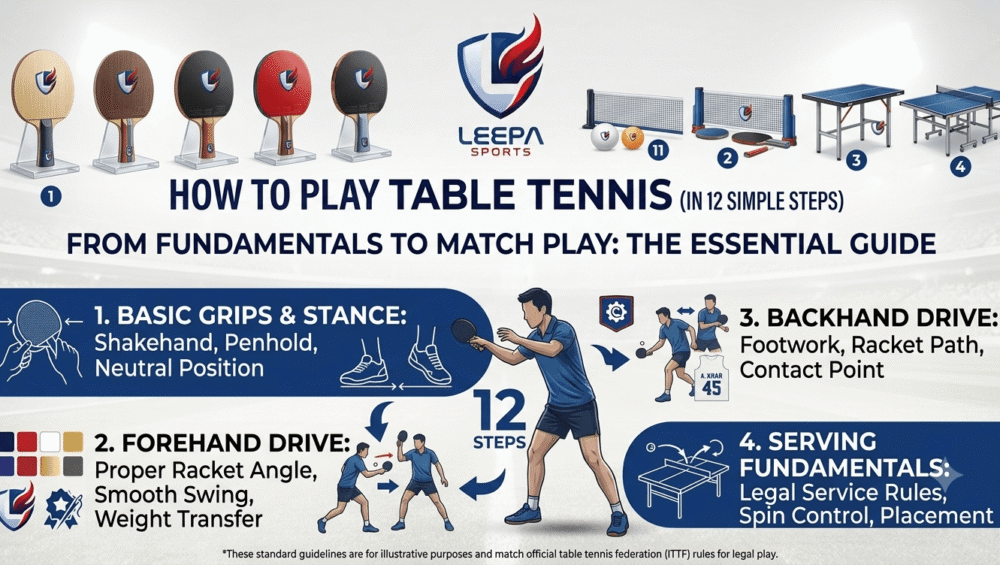
How to Play Table Tennis: 12 Simple Steps for Beginners

How to play table tennis becomes much easier when you learn each skill one by one. First, learn how to hold the racket and stand correctly. Then, practice your serve, forehand, backhand, and returns. 

Want to learn table tennis but do not know where to start? This fast and exciting game may look difficult at first, but the basics are simple to learn. With the right steps, you can learn the basic shots, serve, movement, and rules with ease.

1. Learn the Table Tennis Equipment

Start by learning the basic equipment. You need a table tennis table, a racket, a ball, and a net. The table has a net in the middle. Each player stands on one side. The racket helps you hit the ball over the net. 

Pro Tip: Choose comfortable Table Tennis Apparel before you start playing. Good sports clothing should let you move your arms and legs freely. Leepa Sports offers sports clothing for active players who want comfort during practice. So, start with the right equipment and clothing. Then, you can focus more easily on learning the game.

2. Hold the Racket Correctly

The way you hold the racket can affect your control. Start with a simple shake-hand grip. Hold the racket as if you are shaking hands with it. Keep your grip firm but relaxed. Do not squeeze the handle too hard. Ask a partner to slowly roll the ball toward you. Try to return it with a short swing. Also, keep your wrist relaxed. This can help you control the ball better. 

3. Get Into the Ready Position

The ready position helps you prepare for the next shot. First, stand with your feet about shoulder-width apart. Keep your knees slightly bent. Then, lean your body a little forward. Hold your racket in front of you. Keep your eyes on the ball. A relaxed and ready body makes it easier to react.

4. Learn How to Serve

The serve starts each point in table tennis. Therefore, learning a simple serve is very important. First, hold the ball in your open hand. Then, toss it up and let it fall. Hit the ball so it bounces on your side first. Then, it should move over the net and bounce on your opponent’s side. 

Next, practice serving to different areas. Try serving toward the middle, then toward the sides. Also, keep your serve low when you can. A low serve can make it harder for your opponent to attack. However, beginners should focus on control before advanced tricks. 

Pro Tip: Practice ten or twenty serves at a time. 

5. Practice the Forehand Stroke

The forehand stroke is one of the first shots beginners should learn. Start in the ready position. As the ball comes toward your forehand side, move your racket back a little. Then, swing forward and contact the ball in front of your body. Keep the swing smooth. Do not try to hit the ball as hard as you can. Instead, focus on control and direction.

Practice with slow balls first. Ask a partner to send the ball to your forehand side. Return the ball with a simple stroke. Then, repeat the drill several times.

Also Read: 10 Training Tips for Practicing Tennis

6. Learn the Backhand Stroke

The backhand stroke helps you return balls that come to your other side. Start from the ready position. Keep your racket in front of your body. When the ball comes toward your backhand side, move your racket slightly back. Then, move it forward and hit the ball in front of your body. 

Ask a partner to feed slow balls to your backhand side. Try to return each ball over the net. Focus on keeping the ball on the table. Then, slowly increase the speed. Also, try to keep your body balanced.

7. Learn to Return the Ball

Returning the ball is a key part of table tennis. After your opponent hits the ball, watch its direction carefully. First, get into your ready position. Then, move toward the ball. Try to contact it in front of your body. Use a short swing when possible. Your goal is to return the ball safely. You do not need to win every shot.

Start with slow rallies. Ask your partner to hit easy balls toward your forehand and backhand sides. Return each ball with control. Then, ask your partner to change the direction. This will help you practice your reaction.

8. Practice Simple Rallies

A rally happens when players keep hitting the ball back and forth. Beginners should practice simple rallies before trying difficult shots. Start with your partner standing close to the table. Hit the ball slowly. Try to keep it on the table. Count how many shots you can make in a row. Then, try to beat your own number.

9. Learn Basic Spin

How to play table tennis become a challenging question, when you don’t learn the basic spin. Spin can change the way the ball moves. However, beginners should learn it slowly. Start with simple topspin. Move your racket upward and forward as you hit the ball. This creates a forward spin.

10. Improve Your Footwork

Good footwork helps you reach the ball at the right time. Table tennis moves can happen very quickly. Therefore, you need to stay ready. Start with small side steps. Move to the left, then return to the centre. After that, move to the right. Keep your knees slightly bent.  

11. Practice With a Partner

A partner can make table tennis practice more useful. First, choose someone who can play at a similar level. Then, decide what you want to practice. You may focus on forehands, backhands, serves, or returns. Keep the first drills simple. Hit the ball slowly and give each other time to react.

12. Play Simple Games and Keep Practicing

After learning the basic skills, start playing simple games. Use the rules you have learned. Begin each point with a serve. Then, try to keep the rally going. Focus on good movement and control. Do not worry about winning every point. Instead, use the game to practice your new skills.

After each game, think about what you did well. Then, choose one skill to improve. Maybe your serve needs more practice. Or perhaps you need better footwork. Write down your goal for the next session. 

Choose Leepa Sports for Your Table Tennis Uniform

Looking for sports clothing that matches your table tennis game? Leepa Sports offers sportswear made for active players. A good table tennis uniform should feel comfortable and allow easy movement. 

You can choose Custom Table Tennis Shirts for your club, school, or team. Add Table Tennis Shorts for a complete and comfortable look. Contact Us Today!

Conclusion

How to Play Table Tennis becomes easier when you learn the game one step at a time. Start with the equipment, grip, ready position, serve, and basic strokes. Then, work on rallies, spin, footwork, and match play.

How to Play Table Tennis also takes regular practice. So, stay patient and keep learning. It also takes regular practice. So, stay patient and keep learning. Wear comfortable Table Tennis Apparel and practice with confidence. With Leepa Sports, you can also find custom fits and game-ready options.

FAQs

1. How do I start playing table tennis?

Start by learning the basic equipment, racket grip, ready position, serve, forehand, and backhand. Then, practice simple rallies with a partner.

2. Is table tennis easy for beginners?

Yes. Beginners can learn the basic skills with regular practice. Start slowly and focus on control before speed.

3. How often should I practice table tennis?

Try to practice regularly. Even short practice sessions can help. Focus on one or two skills during each session.

4. How can I improve my table tennis footwork?

Practice small side steps and return to the ready position after every shot. Also, keep your knees slightly bent.

5. How can I improve my table tennis serve?

Practice your toss first. Then, work on a smooth racket movement. Focus on accuracy before trying advanced spin.

Select the fields to be shown. Others will be hidden. Drag and drop to rearrange the order.
  • Image
  • SKU
  • Rating
  • Price
  • Stock
  • Availability
  • Add to cart
  • Description
  • Content
  • Weight
  • Dimensions
  • Additional information
Click outside to hide the comparison bar
Compare
Shopping cart close